Neuroplastic Pathways- How Prayer Reshapes the Mind
We  often think of prayer as a spiritual exercise — a conversation with God, a means of comfort, guidance, and connection. And it absolutely is. And science is beginning to confirm what faith has long known: prayer doesn’t just change our hearts; it changes our brains.

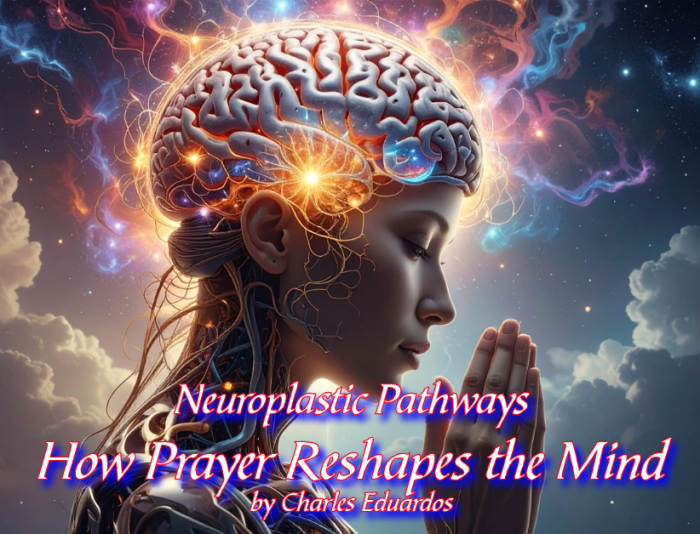
The concept of neuroplasticity — the brain’s ability to reorganize itself by forming new neural connections — reveals that our thoughts, habits, and focus literally shape the architecture of our minds. Prayer, it turns out, is one of the most powerful tools we have to influence that transformation.

The Mind of Christ — Wired into Our Biology

Paul wrote, “Be transformed by the renewing of your mind” (Romans 12:2). That wasn’t just poetic encouragement — it was profound truth. Modern neuroscience now shows that focused, intentional practices like prayer and meditation can rewire the brain, strengthening areas associated with compassion, peace, and emotional regulation, while quieting those linked to fear, anxiety, and reactivity.

When we pray — when we center our thoughts on God’s presence, love, and truth — we are not only communing with the Divine but also retraining our neural networks to align with faith rather than fear. Over time, consistent prayer begins to carve new mental pathways of hope, trust, and resilience.

What Happens When We Pray

During prayer, especially deep, contemplative prayer, brain scans show increased activity in the frontal lobe — the region responsible for focus, decision-making, and empathy — and decreased activity in the amygdala, which triggers stress and fear responses.

In simple terms, prayer literally helps calm the “fight or flight” center and strengthens the “peace and purpose” circuits. That’s why people who maintain a regular prayer life often experience greater emotional stability, clearer thinking, and a stronger sense of well-being.

It’s as though the Creator designed our brains to respond to communion with Him — to thrive when aligned with divine presence.

Faith as Formation

Prayer, then, is not escapism. It’s formation. It’s the rewiring of our inner world so that it reflects heaven’s reality rather than the world’s chaos. When Jesus withdrew to pray, He wasn’t retreating — He was resetting. He was restoring His inner alignment with the Father.

And we can do the same. Each time we pause to pray, to breathe deeply, to release fear and embrace trust, we are training our brains to default toward peace. We are reinforcing the truth that we are not victims of our circumstances but participants in divine transformation.

Creating New Pathways of Peace

The beauty of neuroplasticity is that change is always possible. No matter what patterns of worry, shame, or negativity have been ingrained, prayer offers a way to renew and reshape them. It’s the daily practice of returning — again and again — to God’s presence until His peace becomes our natural state. So when Scripture calls us to “pray without ceasing” (1 Thessalonians 5:17), it’s not just spiritual advice — it’s a neurobiological invitation. The more we practice communion with God, the more our brains, bodies, and lives reflect His love and wisdom.

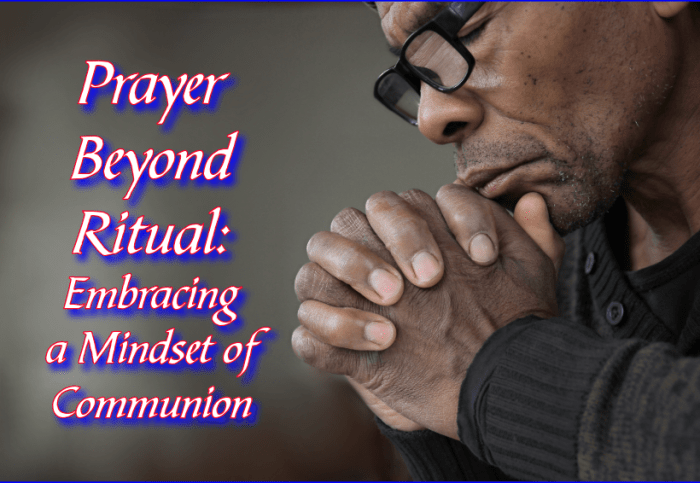
Prayer Beyond Ritual: Embracing a Mindset of Communion

There’s something sacred about those quiet moments when we pause to pray — when the noise fades, and our hearts turn toward the Divine. Yet, for many, prayer has become a ritual: a series of words spoken by habit, a checkbox on the spiritual to-do list, a performance of piety rather than a posture of presence.

But true prayer — the kind that transforms hearts and reorders lives — is not a ritual. It’s a relationship. It’s not about reciting the right words, but about being present with the right heart. Prayer is not merely something we do; it’s a way of being — a continual awareness of God’s nearness and a conscious participation in His presence.

From Ritual to Relationship

When Jesus taught His disciples to pray, He didn’t offer them a formula to follow but a framework for connection: “Our Father…” (Matthew 6:9). With those two words, He redefined prayer. It’s not about distance; it’s about intimacy. It’s not performance; it’s communion.

Rituals have their place — they can ground us, remind us, center us. But when the ritual becomes the goal rather than the gateway, we miss the heart of prayer. We end up going through the motions while our spirits remain untouched. God invites us to more — to move beyond form into fellowship.

Living in Communion

Prayer is not confined to a particular time or place. It’s the atmosphere of a heart attuned to God’s Spirit. It’s the whisper of gratitude while washing dishes, the silent plea for strength in a meeting, the wordless awe before a sunset.

Paul captured this beautifully when he wrote, “Pray without ceasing” (1 Thessalonians 5:17). He wasn’t suggesting nonstop verbal prayer but a continuous state of communion — a heart that remains open and responsive to the presence of God.

When prayer becomes our posture, every moment is holy ground. We begin to see God not only in the sanctuary but in the supermarket; not only during morning devotions but in the rhythm of daily life.

The Transforming Power of Presence

When we embrace prayer as communion, transformation follows naturally. We begin to see ourselves, others, and the world through God’s eyes. Our reactions shift from fear to faith, from control to surrender, from striving to resting.

This kind of prayer doesn’t just change our circumstances — it changes us. It molds our character, softens our hearts, and anchors our souls in divine love. In communion, we stop speaking at God and start living with Him.

A Daily Invitation

So, how do we move from ritual to relationship?

Start with awareness. Slow down. Breathe. Recognize that God is already here — in this very moment. Speak to Him honestly. Listen deeply. Let your prayer life expand beyond words into the quiet recognition that you and the Creator of the universe are in constant conversation.

Prayer, in its purest form, is not an event but an environment — the air of the Spirit we breathe.

As we embrace this mindset of communion, our hearts will begin to echo with the words of the psalmist:

I have set the Lord always before me; because He is at my right hand, I shall not be moved” (Psalm 16:8).

When prayer becomes communion, life itself becomes prayer.

Hope in an Age of Overwhelm

We don’t have to look far to see a world that feels frayed at the edges. Wars erupt. Economies wobble. Political divisions deepen. Even the news ticker scrolling across our screens can feel like a slow drip of despair. Many are asking, “How do I hold onto hope when everything feels overwhelming?” I believe the answer is not in denial, but in remembering who we are and where we are rooted.


Hope Is Not Naïve

Christian hope is not wishful thinking or blind optimism. It is not putting on rose-colored glasses and pretending everything is fine. Hope is the stubborn insistence that God is still God—that even when the waves roar, there is an anchor holding firm beneath the surface. As Paul reminds us, “We have this hope as an anchor for the soul, firm and secure” (Hebrews 6:19).

That kind of hope doesn’t ignore the storm. It simply refuses to be defined by it.


Small Practices in a Big World

When the world feels overwhelming, we need practices that shrink life back to human size. Here are three that have carried me—and might carry you, too:

  • Gratitude as Resistance: Every “thank you” whispered to God is a declaration that His goodness is greater than the darkness. Gratitude reframes our focus from scarcity to abundance.
  • Prayerful Breathing: Inhale slowly with the words, “Be still” … exhale with, “and know that I am God.” This simple rhythm reminds us that even our breath is borrowed grace.
  • Limit the Noise: The news cycle profits from your anxiety. Set boundaries. Step away. Re-enter the story of God’s Word, which has carried saints through darker times than these.

A Hope That Spreads

Hope is contagious. When you carry it, others catch it. That’s why the world needs people who will stand in the middle of the chaos and say, “Yes, it is dark—but the light still shines.”

Jesus didn’t promise an easy road. He promised His presence. And that presence makes hope not only possible, but powerful.

So today, when you feel the overwhelm pressing in, choose to plant your feet in that unshakable truth: God is still God. Christ is still risen. Hope is still alive.

And that hope, my friend, is not just for you—it’s for the world aching around you. Carry it. Share it. Live it.

World History Reimagined: Christianity Stays a Jewish Sect

Imagine!

1. The Roman Empire: No State Church, No Crosses on Banners

  • No Constantine’s Conversion: If Christianity remains a Jewish movement, there’s no “Christianization” of Rome in the 4th century. The Roman Empire might stick with its patchwork of pagan cults, or maybe it latches onto something else entirely.
  • No Crusades, No Holy Roman Empire: Without Christianity as a state religion, you don’t get medieval Christendom, crusader armies, or the “Holy Roman Empire.” Europe’s unifying force is more cultural than religious—a wild tapestry, not a monoculture.
  • No Inquisition or Witch Trials: If the Jesus movement never gets power, it doesn’t need to defend it with inquisitions or heresy hunts. Fewer pyres, more discussions.

2. Judaism and Christianity: Frenemies to Family

  • No Antisemitism: The tragic legacy of Christian antisemitism—accusations of “Christ-killers,” pogroms, the Holocaust—never develops if the Jesus movement remains firmly within Judaism. The “othering” that fueled so much violence simply doesn’t have oxygen.
  • Jewish Renewal: Christianity, as a passionate sect within Judaism, could spark periodic spiritual renewals from within—like Chasidism did centuries later. More emphasis on mercy, love, and radical inclusion in the Jewish world.

3. The Western World: Different Foundations

  • No “Christian West” Identity: The myth of “the Christian West” as a civilizational foundation is replaced by a mosaic: more influence from Greek philosophy, Roman law, and diverse religious traditions.
  • Art and Architecture: Imagine cathedrals with more menorahs than statues, and less Gothic spire, more Eastern Mediterranean courtyard. Michelangelo paints Moses and Yeshua side-by-side.
  • Education: Universities may grow out of rabbinic academies, with debate and dialogue at their core—think Talmud study as the model for liberal arts.

4. Global Impact: Gentile Followers, Jewish Roots

  • Gentile Inclusion, but as “Righteous Among Nations”: Gentile followers of Yeshua would be included, but not as a replacement for Israel. Think “honorary family” status—partners in God’s mission, but with humility.
  • No Colonialism in Jesus’ Name: Missions look more like partnerships and dialogue than conquest and colonization. There’s still sharing of good news, but it’s table fellowship, not empire-building.

5. Islam and Interfaith Relations: A Different Story

  • Islam’s Emergence: Islam still arises in the 7th century, but faces a Jewish-Christian fusion rather than a divided landscape. Maybe less antagonism, more theological cross-pollination. Who knows? Jerusalem could become the beating heart of Abrahamic faith collaboration.
  • Interfaith Dialogue: The “People of the Book” idea gets turbocharged—Judaism, Christianity, and Islam see themselves as siblings (with squabbles, but fewer wars).

6. Modernity: No Christian-Nation Politics

  • Secularism Arrives Differently: The rise of secularism isn’t a rebellion against church control, but a natural outgrowth of pluralism and lively debate.
  • Civil Rights and Liberation: Movements for justice and equality might draw on prophetic and Jesus-centered Jewish thought—think MLK quoting Amos and Jesus at the same time.

Quick Takeaways:

  • Fewer religious wars, more religious arguments (which, let’s be honest, are often just as lively).
  • A global family table, not a worldwide throne.
  • The Jewish story is honored and fulfilled, not replaced or erased.
  • Less cultural uniformity, more colorful patchwork.
  • No “us vs. them” Christian identity—just an ever-expanding tent, with a lot of lively discussion under the stars.

Closing Thought:

If Christianity had never broken off from Judaism, history would be less about empires and more about extended family—sometimes arguing, sometimes hugging, always learning. Maybe, just maybe, there’d be a bit more shalom and a bit less sword. And who knows? Maybe the world would have a few more tables, a few fewer thrones, and a lot more questions asked in love.


Ready to dig deeper? I’d love to hear your thoughts and keep the conversation going. After all, family dinners are best when everyone brings something to share.